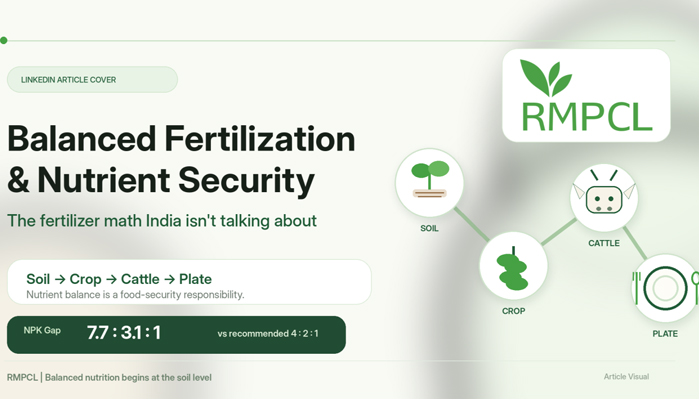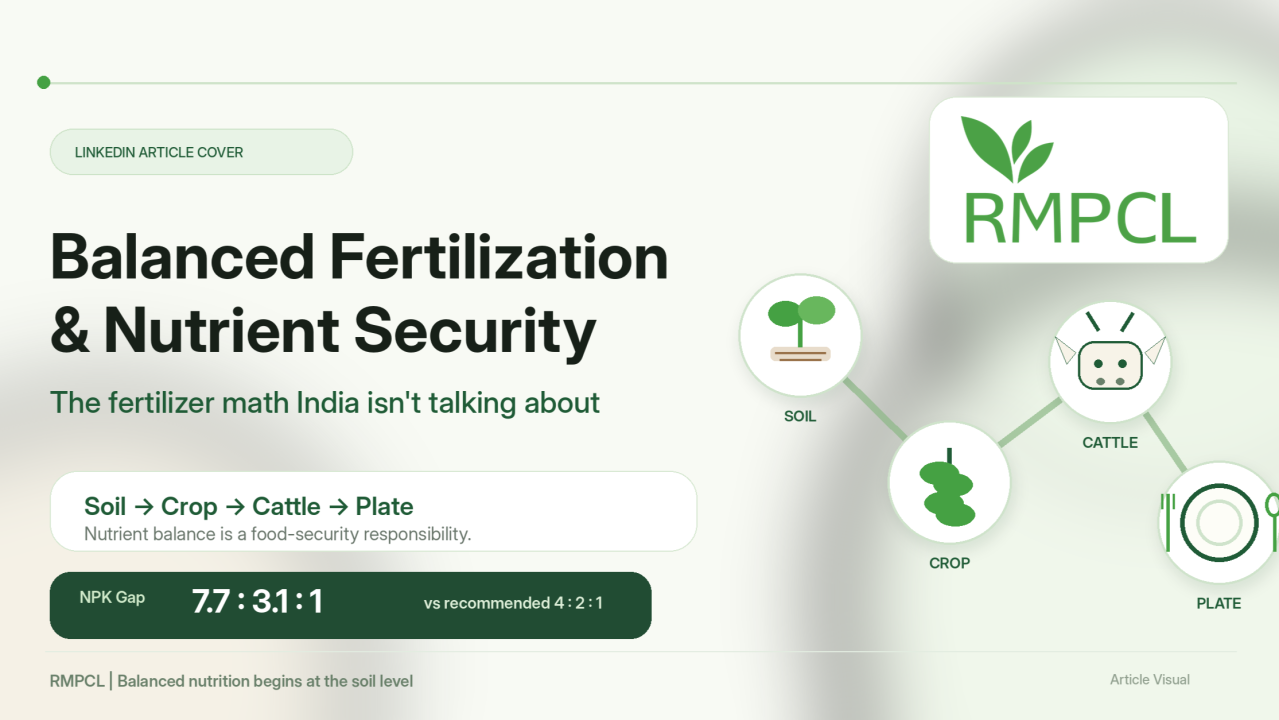
Here's a number that should stop the agriculture industry in its tracks: per India's Fertilizer Statistics data, the country's nitrogen-phosphorus-potassium consumption ratio stands at roughly 7.7:3.1:1, against an agronomically recommended ratio of 4:2:1.
That's not a rounding error. That's decades of farmers over-applying nitrogen—heavily subsidized, cheap, easy to source—while phosphorus, potassium, and the micronutrients that actually determine crop quality get quietly skipped.
The result doesn't stay in the soil. It travels.
Nearly half of India's soil is now zinc-deficient. More than a third is boron-deficient. Iron, manganese, and copper deficiencies are widespread enough that agricultural scientists now describe multi-micronutrient deficiency as the norm, not the exception, across large parts of the country.
Crops grown in this soil don't fail outright—they just come up short. Lower nutrient density. Weaker disease resistance. Yields that plateau even as fertilizer volumes go up, because the plant is getting plenty of nitrogen and almost nothing else it needs to actually convert that nitrogen into a nutritious crop.
This is the part of the fertilizer conversation that rarely gets airtime. The industry talks about yield. It talks less about what's actually in the yield.
That depleted soil doesn't just feed people directly—it feeds livestock too, through fodder and crop residue, which make up roughly 70% of what Indian cattle actually eat.
Studies across multiple states have found copper deficiency in over 80% of dairy cattle tested, manganese deficiency in close to 90%, and zinc deficiency at similar levels—all traced back to mineral-poor soil and feed. The downstream effect is measurable: correcting these deficiencies through mineral supplementation has been shown to lift milk yield by 10–13% in field trials, alongside better fat content and improved reproductive performance in the herd.
In other words, a soil that's short on minerals doesn't just grow a weaker crop. It quietly caps how much milk a farmer's cattle can produce and how healthy that herd stays.
Follow the chain far enough and it arrives at a number that's hard to sit with: nearly half of the world's population affected by micronutrient malnutrition—what public health researchers call "hidden hunger"—lives in India.
More than half of Indian women and roughly two-thirds of children under five are anemic. Over 80% of Indian adolescents carry some form of multiple micronutrient deficiency. This isn't hunger in the visible sense—these are people eating enough calories, often enough rice and wheat, but still coming up short on the iron, zinc, and vitamins their bodies need to grow, think, and fight off illness.
Economists have put a number on what this costs the country: an estimated 4% of India's GDP, year after year, lost to the downstream effects of micronutrient malnutrition — reduced productivity, higher healthcare burden, and a workforce that's chronically under-resourced at a biological level.
Soil to crop. Crop to cattle. Crop and cattle to plate. It's the same nutrient gap, showing up three times.
None of this happens because agri-input companies are careless. It happens because the industry has historically been built to answer one question—"How do we grow more?"—when the more important question has always been "How do we grow better?"
Nitrogen is cheap, and its effect on yield is immediate and visible, so it gets prioritized. Zinc, boron, and balanced phosphate application don't show up as dramatically in a single season, so they get treated as optional. That's a rational response to short-term incentives. It's also exactly how a country ends up with soil running six times over its recommended nitrogen ratio while its children run anemic.
Fixing this isn't about selling farmers a different product. It's about agri-input manufacturers treating nutrient balance — not just volume — as the actual product.
A handful of phosphate and fertilizer manufacturers have quietly built their entire manufacturing philosophy around this — treating balanced, traceable, nutrient-complete formulations as the baseline, not an upsell. RMPCL is one of them; it's a line the company drew for itself well before "nutrition security" became an industry talking point.
That's not a claim that gets made through a tagline. It shows up in batch testing, in traceability from raw material to dispatch, and in formulations built around what soil and crops actually need—not just what moves volume fastest.
The fertilizer sector doesn't need another company announcing a repositioning. It needs more manufacturers willing to treat the soil-to-plate chain as their actual job, not a downstream side effect of selling products.
Because the math is already public. The deficiency data is already published. The only open question is how many companies in this industry are willing to build around it before the next NFHS survey comes out.